
By Michael Nielsen | Editor, Diesel Shop Docs
A trailer repair invoice template needs to look different from a truck invoice in a few specific ways — no engine, no mileage in the usual sense, but axle, suspension, brake, and tire systems that carry just as much weight in a repair job. Diesel Shop Docs' free generator builds one in your browser: no account, no software, no reformatting a truck-focused template to make it fit a trailer job. Enter the details once and download a clean, professional invoice PDF.
Key Takeaways
- A trailer repair invoice needs trailer-specific fields — axle count, suspension type, brake system — not the engine-focused fields a truck invoice uses.
- A trailer over 10,001 lbs GVWR is legally its own commercial motor vehicle under FMCSA rules, with its own separate inspection and recordkeeping obligations.
- There's no engine mileage to reference on a trailer — track service intervals by date or by the tractor's mileage at time of service instead.
- The free Diesel Shop Docs template is browser-based, requires no account, and works for dry vans, reefers, flatbeds, and lowboys alike.
- Trailers often sit for weeks between hookups — consistent, dated invoices matter more here than on equipment that's used daily.
In This Article
- What Makes a Trailer Invoice Different From a Truck Invoice
- Why Trailers Are Their Own Vehicle for Recordkeeping Purposes
- How the Free Trailer Repair Invoice Template Works
- Customizing Your Invoice: Logo and Branding
- Trailer Type Differences That Actually Affect the Invoice
- Common Trailer Invoicing Mistakes
- FAQ
What Makes a Trailer Invoice Different From a Truck Invoice
Start from the same baseline any repair invoice needs. Per the FTC's consumer guidance on auto repair, a completed repair invoice should describe each repair performed, the parts supplied and their cost, and labor charges. That much doesn't change between a truck and a trailer.
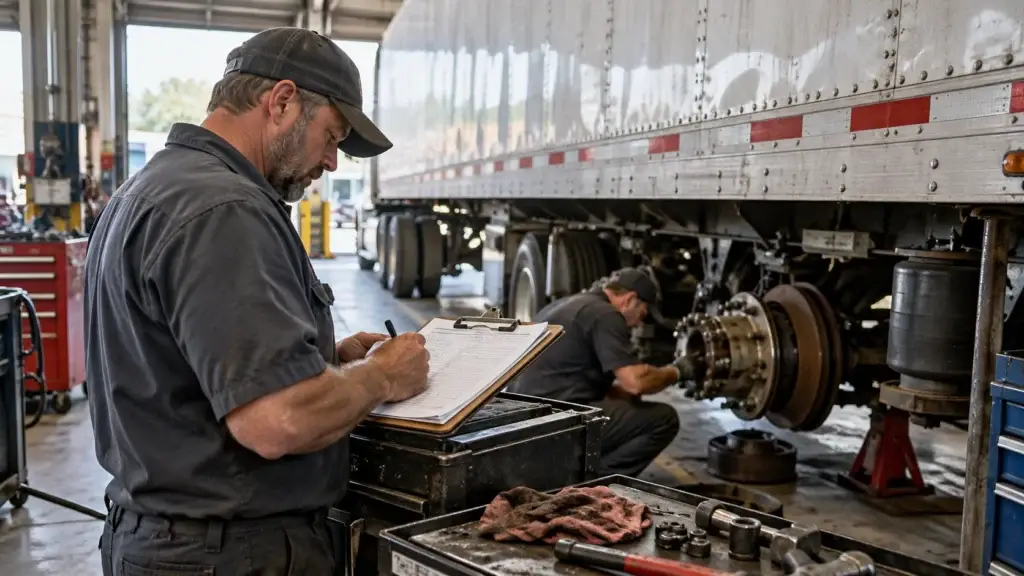
What changes is the field set underneath it. A truck invoice is built around an engine — mileage, engine hours, fuel system components. A trailer has none of that. In its place: axle count and configuration, suspension type (spring, air-ride), brake system (drum, disc, ABS), tire and wheel-end details, and — for reefers — the refrigeration unit as its own line item entirely separate from the trailer's mechanical systems.
Without mileage as a reference point, dates carry more weight on a trailer invoice than they do on a truck one. A trailer that sits in a yard for three weeks between loads doesn't accumulate mileage that would otherwise flag it for service — the calendar is often the only signal a shop or fleet has that something's due.
There's also a scope difference worth naming directly: a truck invoice frequently covers a single system — the engine, the fuel system, the electrical system. A trailer invoice more often covers several unrelated systems in one visit, because a trailer that's already in the shop tends to get its brakes, its lights, and its tires all looked at at once rather than scheduling three separate visits. That makes itemization matter even more on a trailer invoice — a customer or fleet manager needs to see clearly which charge belongs to which system, not one lump "trailer service" line covering three unrelated repairs.
Why Trailers Are Their Own Vehicle for Recordkeeping Purposes
It's easy to assume a tractor's clean paperwork covers whatever trailer happens to be hooked to it. It doesn't. Under 49 CFR 396.17, the term commercial motor vehicle explicitly includes each vehicle in a combination — for a tractor-semitrailer combination, the tractor and the semitrailer must each be inspected separately. A trailer over 10,001 lbs GVWR is its own regulated vehicle, with its own inspection and documentation obligations, independent of whatever tractor happens to be pulling it that week.
That has a direct, practical consequence for invoicing: a trailer's repair invoices need to be identifiable by the trailer's own unit number or VIN, filed as that trailer's own record, not folded into whichever tractor's paperwork happened to be handy that day. A repair history that's scattered across whichever truck pulled the trailer during a given job is functionally no repair history at all when someone actually needs to reconstruct it.
This matters most at exactly the moment it's easiest to overlook: a trailer swap. A driver drops one trailer and picks up another mid-route, and if the paperwork habit at your shop is "whatever tractor's in the bay," the trailer's actual maintenance history stays tied to a truck that may never see that trailer again. Filing by the trailer's own identifier from the start avoids this entirely — the record follows the trailer, not whichever tractor happened to be attached when the invoice was written.
How the Free Trailer Repair Invoice Template Works
The workflow takes a few minutes, built around trailer-specific fields from the start:
- Enter your shop details. Name, address, phone, and logo — saved once with "Remember My Shop" for every future invoice.
- Add customer and trailer information. Trailer unit number, VIN, trailer type (dry van, reefer, flatbed, lowboy), and axle configuration.
- Build the line items. Labor and parts specific to what was actually repaired — brakes, suspension, tires, refrigeration unit — with the calculator handling subtotals, tax, and discounts.
- Preview the document. Check it over before it's finalized.
- Download the PDF or print it. Generated entirely in your browser, so nothing has to be uploaded anywhere first.
| Field | Why It's Different for a Trailer |
|---|---|
| Trailer unit number / VIN | The trailer's own identifier — independent of any tractor |
| Trailer type | Dry van, reefer, flatbed, and lowboy all have different systems to document |
| Axle configuration and suspension type | No engine, so this is the closest equivalent identifying detail |
| Date (in place of mileage) | The primary service-interval reference without an odometer |
| Refrigeration unit (if applicable) | A separate system from the trailer chassis itself, billed as its own line item |
| Itemized labor and parts | Same baseline every repair invoice needs |
Customizing Your Invoice: Logo and Branding
Trailer repair work often runs through fleet accounts rather than one-off customers, which makes a consistent, branded invoice more valuable, not less. Diesel Shop Docs lets you upload your shop's logo (PNG, JPEG, or WebP) so every trailer invoice looks like it came from the same professional operation, whether it's job one or job one hundred for that fleet.
"Remember My Shop" saves your logo alongside your business details, so you're not re-entering them across every trailer that rolls through the yard. Everything is processed in your browser — nothing is uploaded to a Diesel Shop Docs server.
Trailer Type Differences That Actually Affect the Invoice
Not every trailer needs the same invoice detail. A dry van's repair scope is mostly structural and mechanical — doors, floor, axles, brakes. A reefer adds an entire refrigeration system with its own service intervals, its own specialist technicians in many markets, and its own parts supply chain, separate from the trailer chassis itself. A flatbed introduces tie-down and deck-hardware line items a dry van invoice never needs. A lowboy adds hydraulic systems for the deck and gooseneck that neither of the others has.
None of this changes the core invoice structure — shop details, customer details, itemized labor and parts, totals. It does mean the line items themselves should reflect what that specific trailer type actually needs, rather than reusing a generic "trailer repair" description that could mean almost anything to whoever reads it later.
Common Trailer Invoicing Mistakes
- Filing a trailer's invoice under the tractor's paperwork. This breaks the trailer's own repair history the moment a different tractor pulls it next time.
- No trailer type or axle configuration noted. "Trailer repair" tells nobody reviewing the invoice later what was actually serviced.
- Treating the refrigeration unit as part of the trailer's general repair. Reefer units have their own maintenance schedule and often their own service provider — keep that line item distinct.
- No date discipline. Without mileage to fall back on, a missing or vague date on a trailer invoice removes the only real reference point for when service is next due.
- Assuming the tractor's clean record covers the trailer. It doesn't — trailers are their own vehicle under FMCSA rules, with their own separate documentation trail.
- Skipping the preview before sending. A wrong axle count or trailer type noted on the invoice is a small error that still undermines the record's usefulness months later.
Create Your Professional Shop Document
Build clean, professional invoices, estimates, quotes, work orders and service reports for diesel repair shops, truck repair businesses, mobile mechanics and fleet maintenance operations.

FAQ
Do I need a separate invoice for the trailer and the tractor?
Yes — even if both were serviced the same day, they're separate vehicles with separate identifiers and, for FMCSA-regulated fleets, separate inspection records. Keeping them as separate invoices keeps each vehicle's history intact.
How do I track service intervals without mileage?
By date, primarily — or by the pulling tractor's mileage at time of service if your fleet tracks that. Either way, consistency matters more than which method you pick.
Does this template work for flatbeds and lowboys, not just dry vans?
Yes — the fields apply across trailer types. Specify the trailer type on the invoice so the record is clear about what was actually serviced.
Is the trailer repair invoice template free to use?
Yes — no subscription, no account, no per-document fee. Generate, download, and print as many invoices as you need.
Does it store my customer or trailer data?
By default, no — document data stays in your browser. Optional features like Remember My Shop store information locally on your own device, and you can clear it anytime.
Should the refrigeration unit be on the same invoice as the trailer chassis repair?
It can be, as long as it's itemized as its own distinct line item — reefer units have separate service schedules and often separate technicians, so lumping the charge in with chassis repairs makes the record harder to interpret later.
What if I don't know the trailer's exact axle configuration?
Note what you can observe or verify — number of axles and general suspension type at minimum. A partial description is still more useful for later reference than leaving the field blank entirely.
The Bottom Line
A trailer repair invoice earns its keep by tracking a vehicle that has no engine, no mileage, and often no daily driver keeping an eye on it — which makes consistent documentation more important, not less. Get the trailer's own identifier, its type and axle configuration, and a clear date on every invoice, and you've built a real repair history for equipment that's otherwise easy to lose track of. Diesel Shop Docs' free generator builds that structure automatically, in your browser, with no account required — see our diesel shop invoice generator guide for the general invoicing baseline this builds on.
Know a Shop Still Filing Trailer Repairs Under the Tractor?
If a shop you know is losing track of trailer repair history because it's buried in the tractor's file, this could save them a real headache later. Worth a forward.